
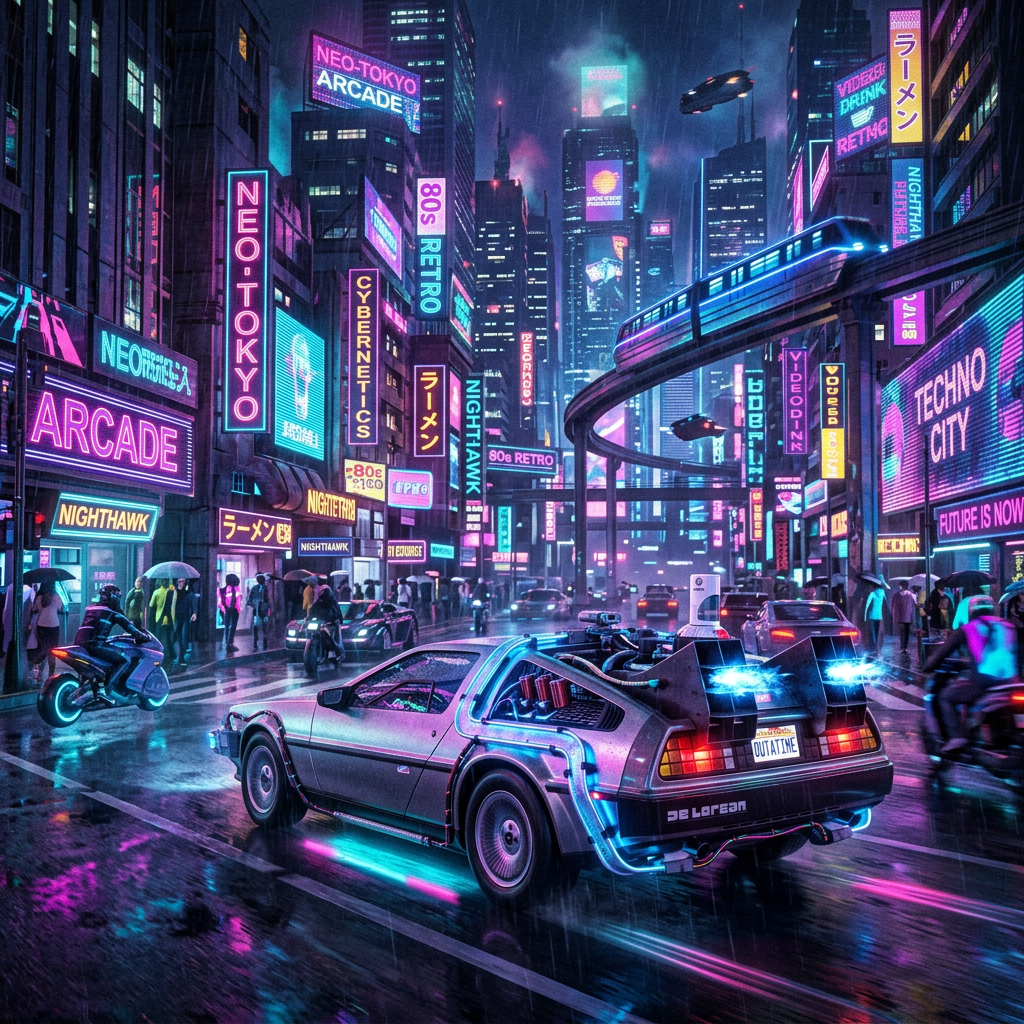
Back to the Future is a movie that, on paper, shouldn’t work nearly as well as it does, yet for a long time I called it my favorite movie.
It is a movie about time travel, the sub-genre of sci-fi that people hand-wring the most over.
Take 12 Monkeys.
Take Primer.
Take Interstellar.
And if you spend more than five minutes thinking about its rules, you’ll quickly realize . . . they don’t make sense. The logic bends whenever it needs to. Marty erases his own existence, yet for some reason the timeline needs to take its own time to erase him.
But, Robert Zemeckis and Bob Gale never pretend the film is about the mechanics. It’s about momentum. It’s about character. It doesn’t get bogged down in the minutia of “how” time travel works, because frankly, it’s unimportant.
Mostly, the success comes from the chemistry between its leads. Michael J. Fox and Christopher Lloyd are one of the great duos in film history. Fox has natural charisma that and Lloyd is all nervous energy and eccentricity (something he channeled very well in Taxi). Together, they create a dynamic that carries the entire movie. Even when the plot threatens to spiral into nonsense, you just don’t care.
Then there are the set pieces—arguably where the film cements its legacy. The movie is structured like a series of escalating payoffs, each one more satisfying than the last. And none is more iconic than the clock tower sequence. From the moment the broken clock tower is introduced early in the film, the story quietly builds toward that lightning strike. It’s textbook foreshadowing, the kind that feels obvious in hindsight but invisible on first watch. By the time Marty is racing against the clock (literally), every element clicks into place: the tension, the stakes, the timing. It’s one of the most perfectly executed climaxes in blockbuster history.
Of course, success breeds continuation, and the sequels. Back to the Future Part II and Back to the Future Part III—are a bit of a mixed bag. They weren’t part of some grand, pre-planned trilogy. You can feel that in their structure, especially in the second film’s increasingly convoluted timeline gymnastics. They’re a little messier, a little less focused. But they’re still undeniably fun. They expand the world, give us more time with characters we love, and double down on the same sense of adventure that made the original special.
And that’s really the key to why Back to the Future endures. It understands what matters. It’s not trying to be a hard science fiction treatise. It’s not concerned with airtight logic or perfectly consistent rules. It’s concerned with being entertaining—relentlessly, confidently entertaining.
It’s a movie powered by charm, precision, and unforgettable moments. The kind of film where every scene has a purpose, every payoff lands, and every character feels alive. The kind of film you can rewatch endlessly and still find yourself caught up in the ride.
